A Texas Department of Public Safety trooper in Madison County stopped a vehicle pulling a stolen trailer and seized 632 catalytic converters, the kind of case Texas pays for with a fee collected on every insured vehicle in the state. The driver faces two state jail felonies. One of them, unauthorized possession of a catalytic converter, carries the same base penalty for 632 converters as it does for one.
The possession law was written to make arrests easy. Punishing the size of a haul falls to the theft statute, and that route runs through the hardest question in any converter case: whose were they?
What DPS has said about the Madison County stop
DPS described the case in a post from its Southeast Texas Region, which KBTX in Bryan and CW39 in Houston reported. According to DPS, the trooper spotted a vehicle, confirmed that the trailer it was pulling had been reported stolen, made a traffic stop and arrested the driver on a charge of theft of property valued at $2,500 to $30,000, a state jail felony. The department's Criminal Investigations Division then joined the investigation and assisted with the converters, and the driver now also faces a charge of unauthorized possession of a catalytic converter, another state jail felony.
DPS has not named the driver. CW39 reported that the department gave no details about where the converters came from, and neither station reported the date of the stop. KBTX published its story Nov. 20. Madison County sits on Interstate 45, roughly halfway between Houston and Dallas.
Texas scrapyards need a VIN and a title for every cut converter
Since Sept. 1, 2021, Section 1956.0321 of the Texas Occupations Code has required anyone selling a catalytic converter to a metal recycler to provide the year, make, model and vehicle identification number of the vehicle it came from, plus a copy of the title or other documentation showing an ownership interest in that vehicle. The recycler may not buy without that paperwork. It must also confirm the converter is consistent with the manufacturer's specifications for the vehicle the seller named, mark each converter it buys with a unique number, and keep a record tying that number to the VIN and ownership documents.
Section 1956.123 of the same chapter adds a second filter. A recycler may buy a removed converter from a person only if that seller acquired it in the ordinary course of business at a salvage yard, a registered metal recycler, a licensed dealer, a repair shop, a licensed used-parts recycler or one of the other businesses the law lists.
A muffler shop that swaps out worn converters has a legal way to sell its old cores. A driver carrying 632 of them would need that kind of business trail, or a title and VIN for each one, to sell the load to a Texas recycler. DPS hasn't said where this load was headed, but the paperwork rules leave few honest explanations for one that size.
Why the possession charge stays flat
The possession offense came from Senate Bill 224, the 2023 law known as the Deputy Darren Almendarez Act. Almendarez was a Harris County sheriff's deputy whose March 2022 death a 2023 Senate bill statement attributed to the converter theft trade. Penal Code Section 31.21 makes it a crime to knowingly possess a converter that has been removed from a motor vehicle unless you own the vehicle it came from or hold the converter in the ordinary course of business. It is a state jail felony, which under Section 12.35 means 180 days to two years in a state jail and a fine of up to $10,000.
The charge rises to a third-degree felony, two to 10 years in prison, only if the person has a prior conviction under the same section, engaged in a conspiracy to steal or damage property involving a converter, or had a firearm. Nothing in Section 31.21 refers to how many converters a person is holding.
Quantity can count under the general theft statute. Section 31.03 presumes that anyone holding one or more removed converters unlawfully took them, with the same owner and business exceptions. Theft of a converter is a state jail felony when the cost of replacing what was stolen is under $30,000. Above that, the ordinary value ladder applies: a third-degree felony from $30,000, second degree from $150,000 and first degree at $300,000. Section 31.09 lets prosecutors add together amounts taken in one scheme or continuing course of conduct. When lawmakers put converter theft on that ladder, the bill analysis for SB 224 said it would give prosecutors the flexibility to aggregate the value of stolen converters to go after crime rings.
My arithmetic, not DPS's: spread across 632 converters, the $150,000 line works out to about $237 apiece and the $300,000 line to about $475. DPS has not put a value on the seizure, and I'm not assigning one.
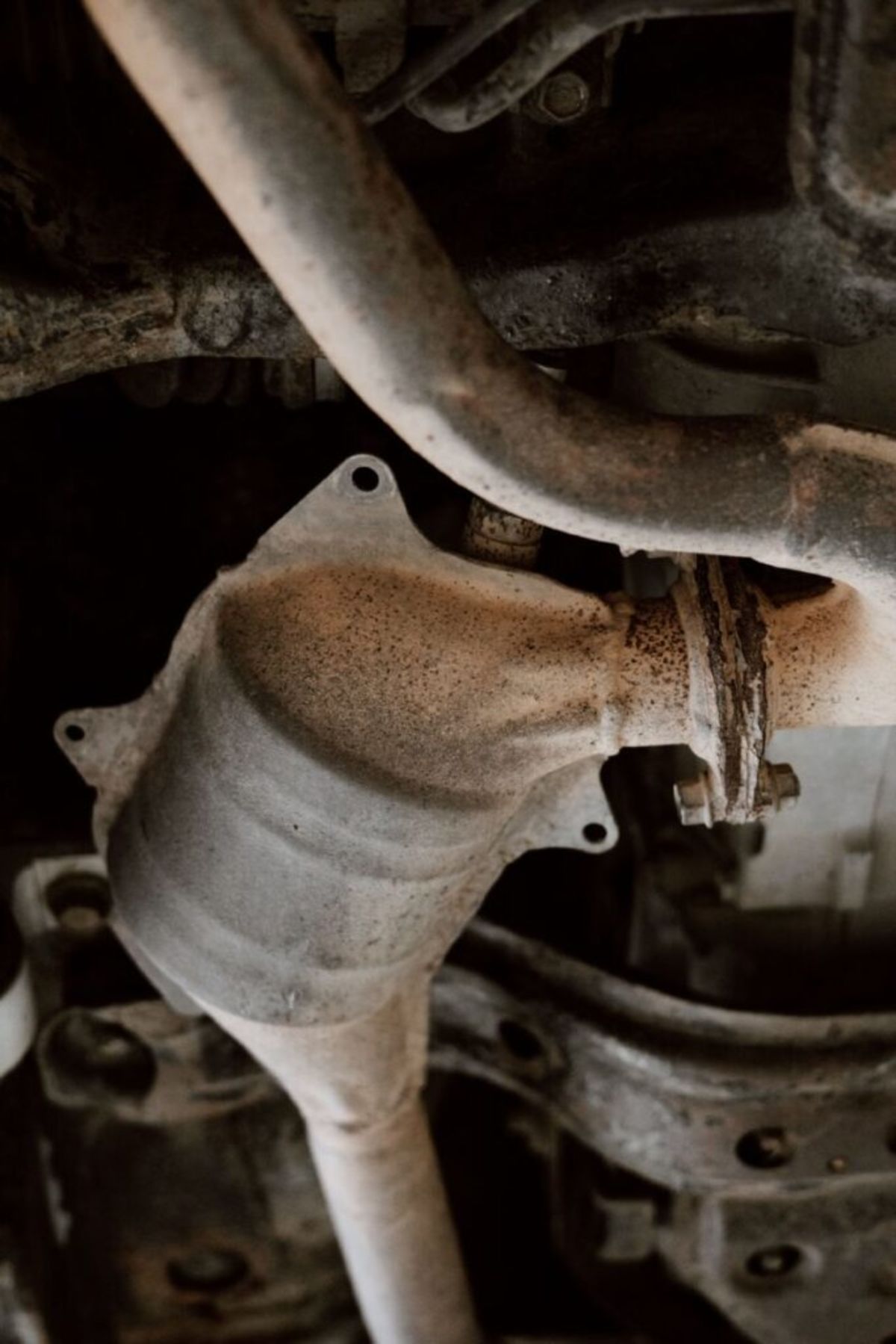
A catalytic converter carries no factory VIN
Photo: Artem Podrez / Pexels
Federal theft-prevention rules don't require a VIN on the exhaust. NHTSA's parts-marking standard, 49 CFR Part 541, requires the vehicle identification number on the engine, transmission, fenders, hood, doors, bumpers, quarter panels and a few other major parts of covered vehicles. The catalytic converter is not on the list.
That gap is why Texas makes recyclers stamp their own number on each converter they buy, and why police keep asking owners to mark theirs. In a Nov. 13 release, Austin police told owners to have the VIN or license plate number etched onto the converter and to consider brightly colored, high-temperature paint. The same release said the department's Henry Sector in southeast Austin received 31 converter theft reports between Aug. 1 and Nov. 8, mostly at apartment complexes.
For an aggregated theft case, prosecutors generally have to show what was taken and from whom. An unmarked converter offers a part number, a saw cut and little else to connect it to a particular car, which is why prosecutors in cases like this one lean on the possession statute.
What Texas drivers pay toward converter enforcement
Under Section 1006.153 of the Transportation Code, insurers pay the Motor Vehicle Crime Prevention Authority $5 for every vehicle-year of coverage they write, and $1 of each fee is deposited to the general revenue fund to be used only for detecting and preventing catalytic converter theft. The MVCPA's FY 2025 activities report says SB 224 raised the fee from $4 to $5, and it shows the converter dollar brought in $28,994,107 in fiscal 2025.
The same report says the authority awarded 82 grants for converter crime that year. Grantees identified 266 prolific converter theft offenders, ran 236 bait operations, held 1,155 etching events and cleared 1,658 converter theft cases, figures the report describes as a snapshot from March 22, 2026, that may still rise. The report does not count converters recovered, so there is no statewide figure to set this seizure against.
Two open questions in Madison County
The first marker is the indictment. A firearm or a conspiracy finding would push the possession charge to a third-degree felony under Section 31.21. An aggregated theft count would require prosecutors to value the converters and tie them to a scheme, which is the work the 2023 law was meant to make possible.
Then there's the question DPS hasn't touched: where the converters came from, and where they were headed. Any that carry an etched VIN or plate number can be matched to theft reports; the rest will be hard to trace to a victim. For owners, the practical lesson is the cheapest one on Austin's list: a VIN etched on the converter is what gives police a way to connect a recovered part to your car.
Should Texas tie the possession penalty to the number of converters a person is caught with, or is the theft statute's value ladder the right tool for a haul like 632?
⚡ Read the full article on The Auto Wire
Sign up for The Auto Wire Newsletter. For the latest news, follow us on Facebook and Instagram.