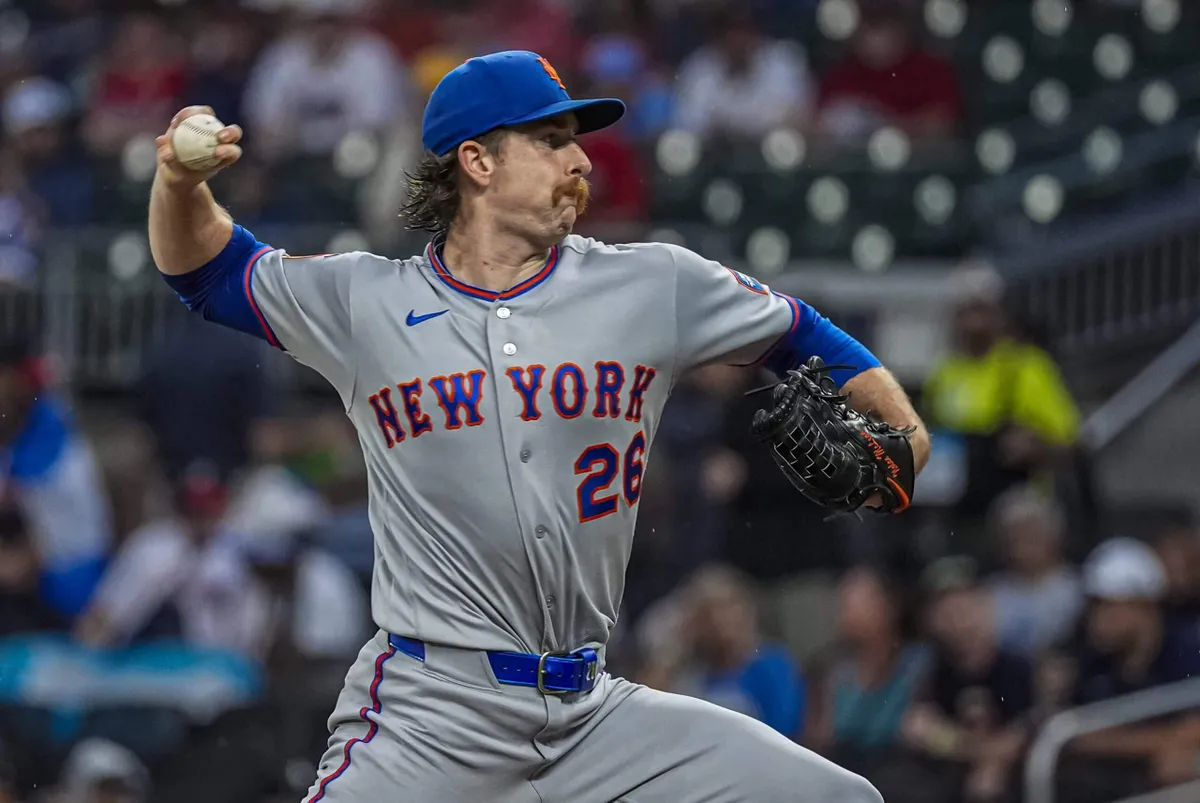
What about Nolan McLean?
It’s the appropriate question to raise after the New York Mets secured two other players coming off their rookie seasons — outfielders A.J. Ewing and Carson Benge — to long-term extensions.
McLean must be next in line to accept a large chunk of money from owner Steve Cohen and president of baseball operations David Stearns, right?
Well, even if he’s interested in staying in New York, his situation is different as a pitcher. The Mets checked in about a possible extension for McLean toward the end of last season, according to league sources who spoke to The Athletic on condition of anonymity because they were not authorized to speak publicly. But often, it doesn’t serve a pitcher well to do a deal before their contract is up.
While several of the game’s exciting up-and-coming position players have recently inked long-term deals, it is notable that some of the best young pitchers like Paul Skenes, Jacob Misiorowski and Cam Schlittler have not.
If pitchers wait until free agency, they get p-a-i-d.
The Mets have clearly had an impressive offseason. With two days left before an expected lockout with a salary cap fight at the center, they’ve shelled out $734 million in guaranteed contracts. Take away Tarik Skubal’s record-setting deal for pitchers worth $450 million, and New York has still outspent every club. Striking an agreement with a homegrown top starter would make it all the more remarkable.
Top League Content
The best comparison for a possible McLean extension is the commitment that the Cincinnati Reds made to Chase Burns in July: seven years, $105 million, valuing two of his free-agent years at about $35 million apiece.
Any possible arrangement between McLean and the Mets may have to resemble Burns’ deal. There’s a case to be made that McLean should fetch more. McLean, the first rookie pitcher to win a Gold Glove Award, has demonstrated an early ability to succeed in New York.
The two right-handers have fairly close numbers. McLean, 25, has pitched in 39 games while Burns, 23, has appeared in 42. McLean owns a 2.93 ERA while Burns checks in at 3.23.
Burns holds the edge over McLean in numerous categories: FIP (3.11 versus 3.46), xFIP (3.25 versus 3.52), whiff percentage (32 percent versus 24.6 percent) and strikeout rate (30.8 percent versus 26.8 percent).
McLean has an advantage over Burns in pitchability and damage control numbers with a lower OPS against him (.621 versus .663), lower hard-hit rate (37.6 percent versus 41 percent) and lower expected slugging percentage (.337 versus .346).
The biggest difference, perhaps, isn’t with the pitchers. It’s with the two teams. The Reds are not the Mets. Pitchers face more injury risk during a long-term deal than position players. The risk-reward calculation for a pre-arbitration pitcher is different for a team like the Reds, who rarely spend large amounts on free agents.
The Mets hold five more years of club control over McLean. That takes him through his age-29 season.
When a pitcher with elite stuff even approaches free agency, he could potentially land what he wants. In April 2025, Garrett Crochet signed a six-year, $170 million extension with the Boston Red Sox. At the time, he had made just 32 career starts. It was the largest contract signed by a pitcher with four-plus years of service time. Before agreeing to the extension, Crochet was set to be a free agent following the 2026 season.
McLean being a pitcher doesn’t make a deal impossible, but inherent challenges exist. It all makes the decision-making process more complicated.
Even for the Mets.
Nov 29, 2026
Connections: Sports Edition
Spot the pattern. Connect the terms
Find the hidden link between sports terms