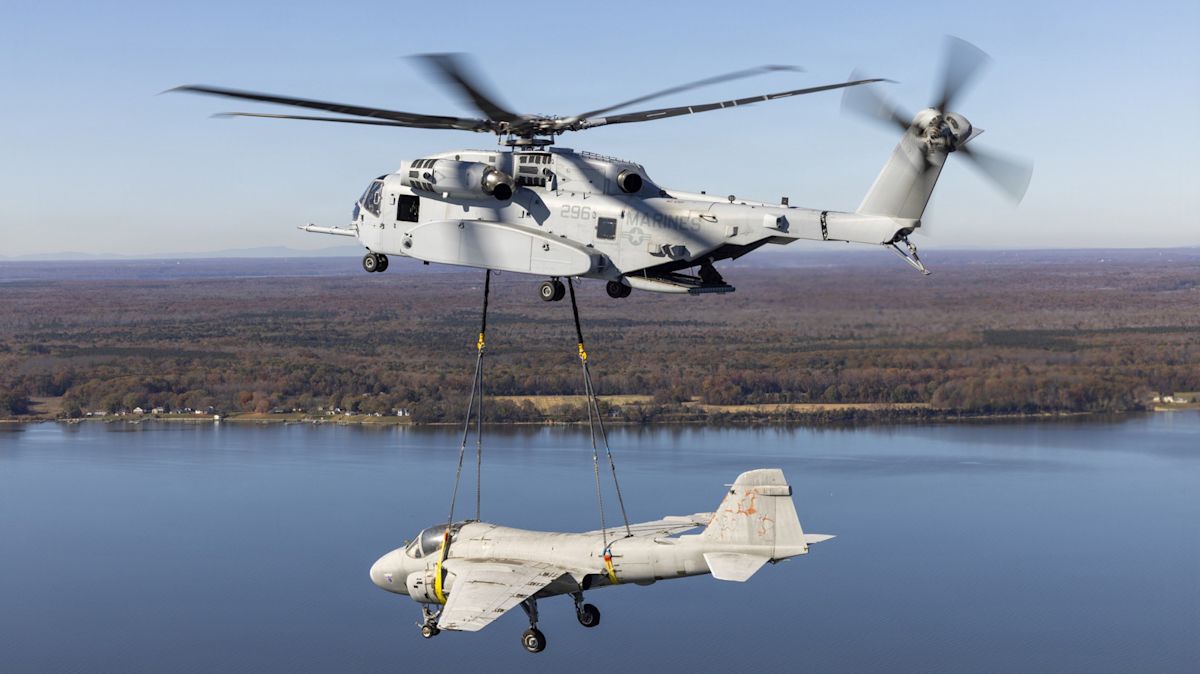
Nearly three decades after it was retired from service, a U.S. Navy A-6E Intruder aircraft took to the skies again in November 2026. This time, however, the classic fighter jet wasn't flying under its own power. Instead, it was airlifted by a U.S. Marine Corps CH-53K King Stallion helicopter, which took the A-6 from the Naval Support Facility Dahlgren, Virginia, to Marine Corps Air Facility (MCAF)in Quantico. According to the U.S. Department of War, the A-6E Intruder was repositioned for "training use", although they stopped short of clarifying the exact nature of training the old plane will be used for.
According to Vintage Aviation News, the external lift was conducted on November 18, 2026, with multiple squadrons — including the Marine Heavy Helicopter Squadron 461, the Ironhorse squadron, along with personnel from Quantico — coordinating the move. Also part of the lift were Marines from the 2nd Distribution Support Battalion, who contributed to rigging the aircraft at Dahlgren. Post-landing, the same team also helped remove the lifting gear off the A-6E.
As for the trip itself, even though it was very short — covering just 18 miles — the entire exercise was a unique spectacle, given that it brought together two vastly different generations of American military aircraft. While the A-6E is a true combat veteran that played a key role in the Vietnam conflict and the Gulf War, the CH-53K King Stallion is the largest helicopter that the U.S. military operates.
Read more: 9 Aircraft With The Most Engines Onboard
Not the heaviest load the CH-53K has carried
U.S. Navy Photo by Erik Hildebrandt
While it's true that a helicopter lifting another aircraft and transporting it several miles away is not something you witness daily, this task was hardly a challenge for the CH-53 King Stallion. As the largest, most powerful helicopter in possession of the U.S. Military, the CH-53 is capable of carrying objects that are far heavier than the A-6E. This is possible because of the CH-53's external loading rating of 36,000 lbs. To put things into context, an unloaded A-6E weighs around 26,660 lbs; that was when the aircraft was functional. The old, decommissioned airframe that was transported recently even had its engines removed (as evident from the photos), thereby making it much lighter.
Since it began test flights in 2015, the CH-53 King Stallion has, on several occasions, lifted much heavier loads. It made headlines in 2018 when, during a test flight, the helicopter lifted a 36,000-pound payload. Since entering service in 2022, the CH-53 has been involved in several heavy lift missions. Notable examples include lifting a stripped, non-flyable 22,000-pound F-35C airframe and transporting it around 305 nautical miles. An F-35B received similar treatment in 2025 after it lifted an F-35B Lightning airframe (also weighing 22,000 pounds).
In fact, the CH-53 has also lifted another of its own kind when, as part of a recovery rigging evaluation, the helicopter lifted another CH-53. This was a stripped-down CH-53 with several of its components removed, but still weighed around 28,000 pounds. Simply put, the CH-53, quite possibly, is the U.S. Military's best bet for heavy-lift missions such as these and is expected to be a valuable asset for the US Marine Corps.
The A-6 Intruder's eventful history
Duttagupta M K/Shutterstock
As for the A-6 Intruder, the aircraft that was lifted and transported by the CH-53, this is a retired twinjet, all-weather attack aircraft that traces its origins to the early 1960s. It is widely thought to be the world's first fully all-weather attack bomber, and was extensively used during the Vietnam War, where it was able to execute complex missions over enemy territory in inclement weather and in the cover of darkness with relative ease. If you're wondering if the A-6E Intruder involved in the lift is a different aircraft, well, it is not. The "E" simply refers to the specific variant of the A-6.
The first iteration of the A-6 Intruder was dubbed the A-6A, with 480 units of these planes built between 1963-69. These were followed by the A-6B, A-6C, and the A-6E variants, with the last one becoming the final variant. The last of the A-6Es were manufactured in 1993. Plans for an A-6F variant never moved beyond the prototype stage.
The A-6 Intruders were powered by various versions of Pratt & Whitney J52-P-8 series engines. The A-6E in question here had twin J52-P-8B engines, each of them capable of producing around 9,300 lbf (41.4 kN) of thrust. Given that the A-6E variants were the last of the A-6 Intruders to be produced, they were also the most modern of the bunch.
The specific A-6E that was transported bears build number 159567 and was delivered to the U.S. Navy in 1975. It was active all through the mid-70s, 80s, and 90s. It was retired in the mid-90s, along with several other frontline A-6s.
Want the latest in tech and auto trends? Subscribe to our free newsletter for the latest headlines, expert guides, and how-to tips, one email at a time. You can also add us as a preferred search source on Google.
Read the original article on SlashGear.