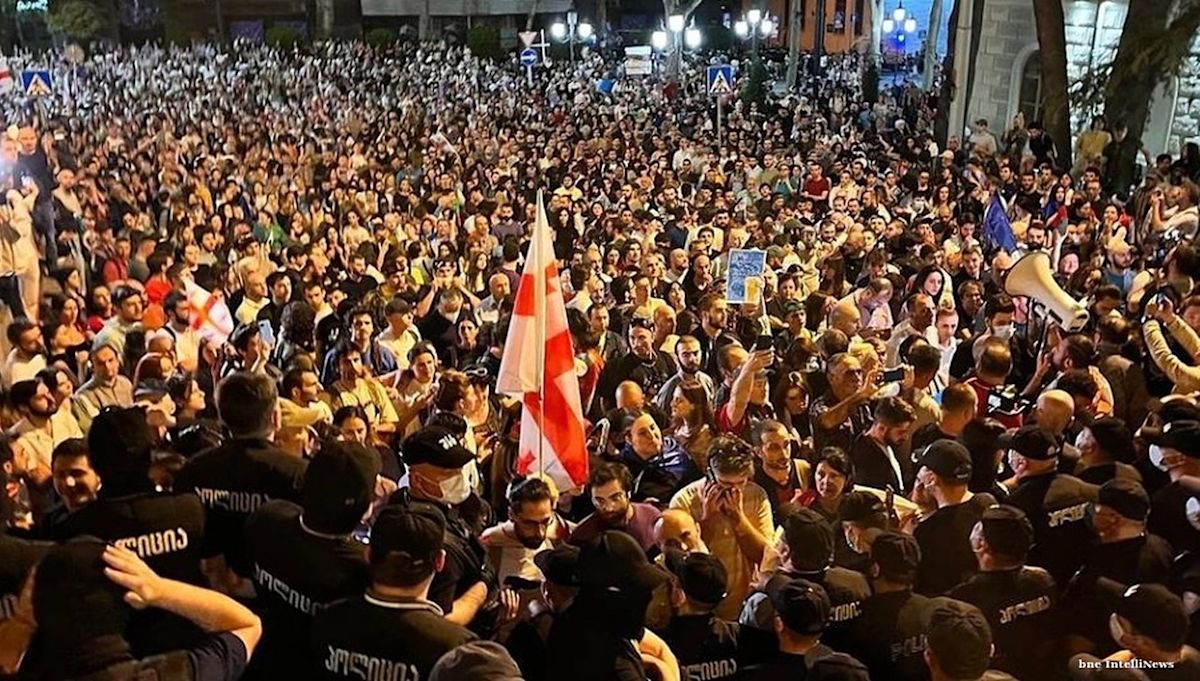
Tens of thousands of Georgians marched through Tbilisi on November 28 to mark two years since the government froze the country's bid to open EU accession talks, TVP World reported.
Three marches converged on Freedom Square, where demonstrators waved Georgian and EU flags and chanted 'Georgia without Ivanishvili' and 'Georgia is Europe'. The crowd demanded that accession efforts resume, that fresh parliamentary elections be held and that jailed protesters be freed, Radio Free Europe/Radio Liberty reported.
The rally came two days before the Constitutional Court resumes hearings on November 30. The court, which opened hearings on October 21, has until June 2027 to rule on the lawsuit brought by 88 Georgian Dream MPs against the United National Movement, Coalition for Change, Strong Georgia-Lelo, the Federalists and For Georgia. The opposition had built towards the date with a 'Georgia Without Ivanishvili' campaign launched in October.
'We have only one test left - the test of numbers,' said Nika Gvaramia, one of the leaders of the Coalition for Change. 'The next demonstration must bring together even more people. Change is here, in the air, and once our numbers grow, change will happen.'
Prime Minister Irakli Kobakhidze announced on November 28, 2024 that Georgia would not seek to open accession talks until at least 2028, less than a year after the EU granted it candidate status. The decision came a month after a disputed parliamentary election returned Georgian Dream to power and set off nationwide protests that have continued daily ever since, reaching 500 consecutive days in April despite arrests, heavy fines and tighter laws on public assembly.
Along with North Macedonia, Georiga is the laggard of candidate countries and yet to open a single chapter.
Montenegro has pulled further ahead since the October chart. It provisionally closed chapters 1 (free movement of goods) and 12 (food safety) on November 6, then chapters 16 (taxation) and 22 (regional policy) at its 31st intergovernmental conference on November 19. That brings it to 25 of 33 chapters closed, with eight still open, and puts its target of finishing negotiations by the end of the year within reach.
The other candidates have not moved. Albania has all 33 chapters open and four closed, though Enlargement Commissioner Marta Kos expects about a quarter to be closed by year-end. Serbia is still stuck on two closed chapters. Ukraine and Moldova still have 24 chapters open each, but that is about to change. EU ambassadors approved the screening of clusters 4 (green agenda) and 5 (agriculture and cohesion) on November 20, after Hungary dropped its veto. Both clusters are expected to open on December 15, which would leave both countries negotiating on every chapter.
Georgia recorded 1,371 demonstrations between November 2024 and November 2026, up from 552 in the previous two years, according to an analysis by ACLED, the conflict and protest monitor. Amnesty International said on November 27 that more than 150 people had been jailed after protest-related trials over the two years, which it called unfair and politically motivated.
Kobakhidze told Imedi TV before the rally that his government remained committed to membership and was 'ready to begin accession talks today' if Brussels agreed, accusing European officials of using the process to 'blackmail' Georgia. The European Commission's 2026 Georgia report, published on November 4, called the country a candidate 'in name only' and said accession could resume only if the authorities recommitted to democratic standards and the rule of law.
Relations with Brussels have soured further in the past week. The European Parliament adopted a resolution on November 26 calling for the release of people it regards as political prisoners and for targeted sanctions on senior Georgian officials, prompting Tbilisi to summon the EU ambassador.
'Our task remains the same - to continue this protest, to expand it, to build a network of resistance,' Giga Bokeria, a leader of the Federalists, told RFE/RL, whether or not the ruling party bans the opposition.